
Why Micro Bakery Inventory and Costing Is So Hard
If you’ve tried to track real ingredient costs and real inventory usage, you already know why this is hard.
When I decided to dive head first into building a real solution for my wife’s micro bakery, my goals were simple. I wanted her to know her actual profit, and be able to organize orders.
Running a cottage or micro bakery usually means you’re producing at home. For us, that meant ingredient costs constantly getting mixed into normal grocery runs. Packaging supplies were scattered across receipts, browser tabs, and random “I’ll remember this later” notes.
She knew revenue was coming in. The problem was everything behind it.
- How much were ingredients and packaging eating into each order?
- What supplies were quietly draining the most money?
- What was she making per hour, after the mess and the cleanup and the “one more batch”?
- Which store partners were actually profitable once you account for waste, discounts, and leftovers?
Spreadsheets can handle it. In the same way a canoe can cross the ocean. My wife is not a spreadsheet person, and honestly, she shouldn’t have to become one just to run a bakery.
Once her business really started picking up, I knew we had to automate the chaos.
So I did what I always do. I went hunting for software that tied the whole operation together. Orders, recipes, costing, inventory, packaging, profit. One place, one system, no duct tape.
And I was kind of shocked. Plenty of tools did one piece. Invoices here, order tracking there, recipe costing somewhere else. Most wanted a monthly subscription for each little slice of the problem.
There were a few apps that claimed to do it all, but they didn’t feel serious. After years in software, you can usually tell the difference between “this is a real product” and “this is a weekend project that escaped containment.” I wanted something solid, partly for my wife, and partly because my pride refuses to ship a half-baked solution to someone I live with.
I started building it for her. Then I realized I was building something legitimately high-caliber. I’ve made successful software for niche operations before, and I recognized the pattern. This problem is bigger than our kitchen. So I decided to build it for everyone dealing with the same fragmented ecosystem and the same lack of visibility.
The part that looks easy, until it isn’t
At first, I was optimistic. The math seems straightforward.
Price - cost of goods (COGS) = profit.
How hard can it be?
This is where a lot of apps stall out. The problem isn’t subtraction. The problem is getting the inputs right.
The conversion problem
How ingredients are purchased is not how ingredients are used.
If a 4 lb bag of sugar costs $3, what does one tablespoon cost?
For a quick example: say sugar costs $0.75 per pound (that’s $3 for a 4 lb bag).
One teaspoon of sugar is 4.125 g, so one tablespoon (3 tsp) is 12.375 g.
A pound is 453.592 g, so that tablespoon is 12.375 / 453.592 = 0.0273 lb.
At $0.75/lb, that tablespoon costs about $0.020 (two cents).
That doesn’t sound like much… until you multiply it across every batch, every product, every week.
We buy ingredients by weight (lb, oz, grams), but most recipes are written in volume (cups, tablespoons, teaspoons). Not always, and yes, grams are better, but that’s not reality for most home bakers.
So the real question becomes:
How do you convert volume-to-weight accurately enough that your inventory and costing aren’t basically fan fiction?
That data exists, sort of. Labs have measured it. The USDA has mountains of it. The catch is that it’s messy. Finding plain, basic ingredients can be weirdly hard when the database includes hundreds of hyper-specific variations. It’s not always “table salt.” It’s “sunflower seeds with salt, ranch flavor, 1 oz package” and 399 cousins.
To make this usable, I built a curated list of 325 “base ingredients” and standardized their conversions. The source data wasn’t consistent (cups-to-grams here, tablespoons-to-grams there, sometimes multiple units for the same item), so I normalized everything into one common format.
I landed on teaspoons-to-grams.
That means each base ingredient has a known “grams per tsp” conversion. Once you have that, you can convert both directions and do real costing and real inventory tracking, even when recipes are written in tablespoons and cups.
Making it usable, not “technically correct but painful”
With conversions handled, the next problem was UI.
To unlock accurate costing and inventory, users need to map their ingredient to one of these base ingredients. Some people will happily weigh everything and enter custom conversions. Respect. That’s not my wife.
My top priority with Mix n’ Batch is reducing friction. I want it to feel helpful, not like a chore you resent.
So I designed ingredient entry around one simple moment: typing the name.
When you start typing into the Name field while adding an ingredient, Mix n’ Batch searches the base ingredients list.
Example: type “sugar” and you’ll see matches like:
- Confectioners’ sugar
- Granulated white sugar
- Brown sugar
Pick the best match using the mouse or arrow keys. As soon as you select one, the grams per tsp field auto-fills.
After that, name it whatever you want. “White Sugar.” “The sweet stuff.” “This is why my jeans don’t fit.” The name is yours. The important part is that the ingredient is linked to a base ingredient, so the conversions work behind the scenes.
What this unlocks
Once sugar is linked and you use it in products:
Your inventory quantity on hand updates based on actual recipe usage
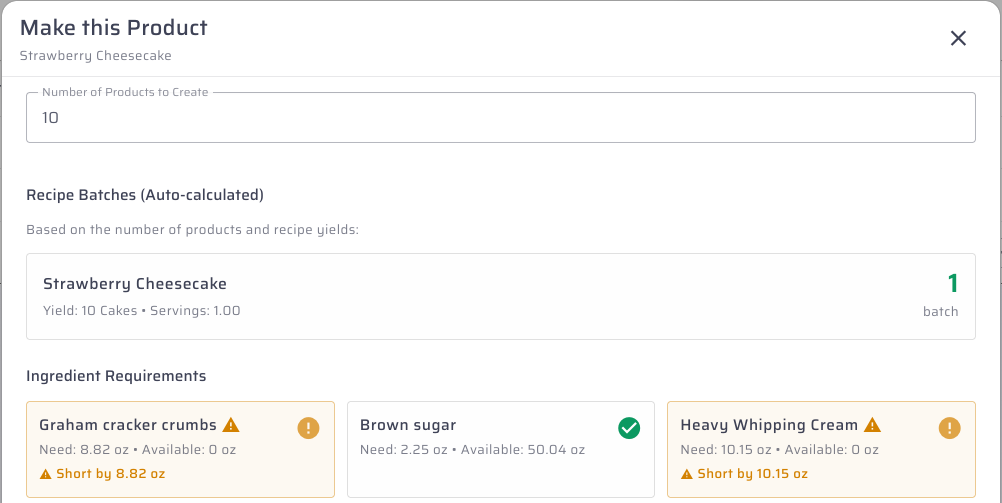
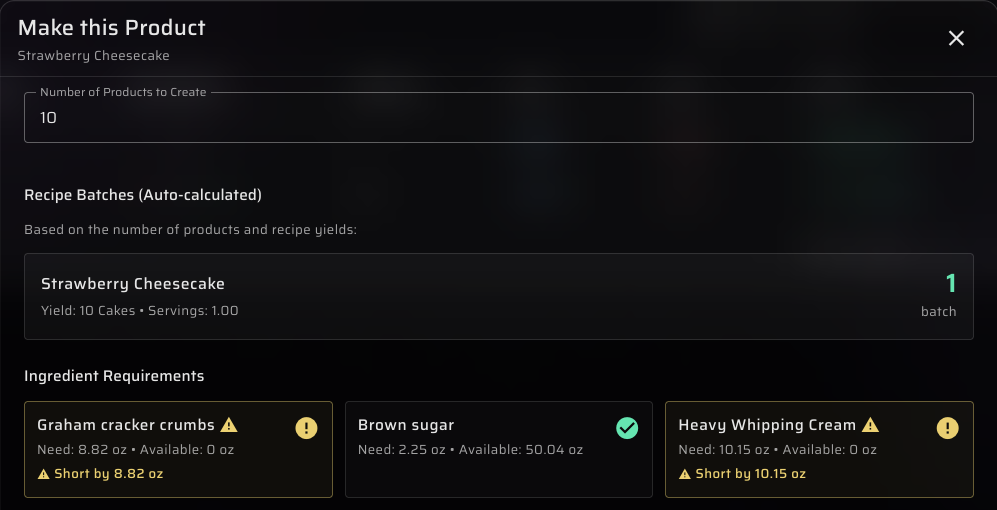
Your cost and profit reflect reality, not guesses


Your stock alerts stay on top of what you’re running low on
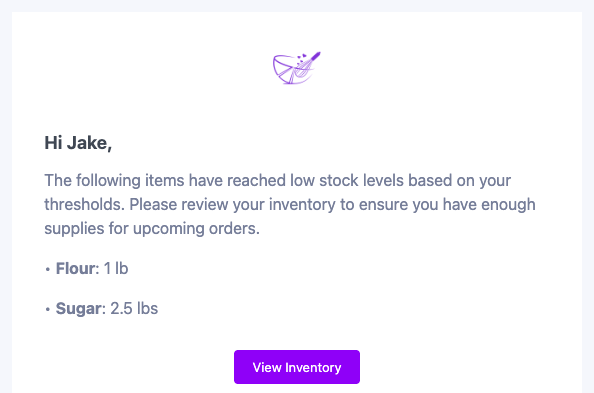
You can glance at your orders and know if you have enough sugar to fulfill them all


TL;DR
Tracking real inventory usage and real costs is hard when recipes are measured in volume (cups, tsp, fl oz) but ingredients are purchased by weight (lb, grams, oz). Mix n’ Batch does the conversion work and ties it to inventory and costing, so you can focus on making the things your customers actually want to buy.
Up next
A reasonable question is: why not just ship Mix n’ Batch with all 325 base ingredients ready to go, so new users don’t have to add ingredients at all?
That’s on the way. Literally a click-of-a-button feature. But there are a couple important challenges to solve so it doesn’t create new pain.
1) Overwhelm in ingredient pickers
If we dump hundreds of ingredients into everyone’s account, adding ingredients to a recipe gets noisy fast. Nobody wants to scroll past “amaranth flour” every time they’re just trying to add flour. So we need a clean UI that lets you choose which base ingredients to import, instead of force-feeding the entire pantry.
2) Imports don’t know your real-world purchasing details
A mass import won’t know:
- what units you buy each ingredient in (5 lb bag, 50 lb sack, 2 oz jar, etc.)
- what you paid for it
- how much you have on hand right now
Careful thought is going into making importing base ingredients easier than typing the handful you use every day, while still getting you to accurate costing and inventory quickly.
And that naturally leads into another upcoming feature: price suggestions. That’s a whole can of worms. Real ingredient price data, especially based on your local store, isn’t easy to get. But I’ve got a few things up my sleeve to make it work.